
AI agents are having their moment.
From coding copilots to autonomous assistants, the industry narrative suggests engineers are on the verge of unprecedented productivity gains. Tools like Copilot, Cursor, and emerging general-purpose agents promise to accelerate development by writing code, debugging workflows, and automating repetitive tasks.
And they do — for software engineering.
But deep tech, hardware, and design engineering operate under entirely different constraints. And increasingly, engineering leaders are discovering that general-purpose agents stop being useful precisely where real engineering begins.
General AI Agents Were Built for Software — Not Systems
The most popular agents are optimized around text and code generation. Their success comes from accelerating narrow workflows like autocomplete, documentation, and lightweight scripting.
Enterprise research increasingly shows this limitation. Coding copilots primarily improve developer efficiency at the task level but fail to address broader system complexity, governance, and operational reliability across engineering workflows.
Deep tech engineers, meanwhile, are not just writing functions. They are:
- Running physics-based simulations
- Validating sensor outputs
- Managing hardware constraints
- Iterating across large parameter spaces
- Coordinating multi-tool engineering environments
Without domain tooling and execution environments, an agent can discuss engineering problems but cannot meaningfully participate in solving them.
Even enterprise adopters report that generic copilots lack customization and reliability for complex, mission-critical workflows requiring specialized knowledge or proprietary processes.
The result: impressive demos — limited production value.
The Enterprise Reality: Agents Fail Without Infrastructure
Across industries, AI agent adoption is hitting the same wall.
Studies show many agentic AI initiatives stall before reaching production because organizations struggle with governance, reliability, and operational oversight. Recent enterprise surveys published by IT Pro reinforce this trend: roughly 1/2 of agentic AI projects remain stuck in pilot phases — with security, compliance, and scalability cited as primary blockers.
One advanced engineering team experimenting with production agents summarized the lesson bluntly:
Deploying agents for real engineering work was impossible without a dedicated “OS” to manage them.
What they discovered aligns with emerging architectural consensus: agents require an infrastructure layer addressing what practitioners increasingly describe as GOOP:
Governance
Clear control over which agents and humans can access specific data, tools, and environments. Autonomous agents introduce real operational risk without strong policy enforcement.
Orchestration
Agents must spin up compute environments and coordinate tools dynamically. Deloitte reports that enterprise analysts now view orchestration as essential for unlocking agent value at scale.
Observability
Organizations need visibility into agent behavior to build trust and reliability. Observability has become a prerequisite for successful agent deployments.
Persistence
Engineering workflows require long-lived environments. Session-based agents restart without context, preventing meaningful progress on complex tasks.
Without these layers, adoption becomes difficult to scale and risky to operationalize.
Sandboxing: The Overlooked Requirement
Another lesson emerging quickly: you do not want powerful engineering agents running unchecked on local machines.
Enterprise governance frameworks increasingly emphasize sandboxed environments where agents operate safely before interacting with production systems.
Why? Because agents are no longer passive assistants — they execute actions.
Without isolation:
- Development environments can be corrupted
- Sensitive IP may be exposed
- Toolchains become unstable
- Compliance risks multiply
In deep tech environments, this isn’t a theoretical risk — it’s operational reality.
Why Customization Is the Real Breakthrough
Foundation models are generalists by design.
Engineering demands specialists.
Research on agentic AI increasingly highlights that value emerges when agents operate within structured workflows, tools, and domain context — not when they operate as standalone reasoning engines.
Customization allows organizations to embed:
- Proprietary simulators
- Domain analyzers
- Validation pipelines
- Internal engineering rules
- Specialized datasets
This transforms agents from coding assistants into something far more useful: junior engineering collaborators capable of preparing simulations, running analyses, and organizing outputs before human review.
Importantly, this doesn’t replace engineers. It removes the repetitive preparation work that slows innovation.
Governance and Model Flexibility Are Becoming Strategic Requirements
As AI expands into regulated industries — defense, aerospace, finance — enterprise readiness is becoming decisive.
Organizations increasingly demand:
- Layered agent context and guiding rulesets
- Audit logging
- Compliance controls
- Data tenancy boundaries
- Secure execution environments
- Model flexibility
Model agnosticism is especially critical. Enterprises want the freedom to switch models based on performance, cost, or regulatory constraints rather than locking workflows into a single vendor ecosystem.
The Real Moat: Domain Ecosystems, Not Models
A second shift is emerging.
The long-term defensibility of agent platforms will not come from models themselves — which are rapidly commoditizing — but from ecosystems of domain-specific services.
Engineering teams need reusable building blocks:
- Data generation workflows
- Simulation engines
- Physics solvers
- Sensor analyzers
- Validation frameworks
As orchestration connects agents into governed systems, ecosystems become the multiplier that accelerates adoption.
In deep tech, the platform that hosts specialized engineering capabilities becomes exponentially more valuable than the agent alone.
AI Is Moving Inside the Engineering Loop
The first wave of AI helped engineers write faster.
The next wave helps engineers operate faster.
But integrating AI deeply into engineering workflows requires infrastructure that most agent tools were never designed to provide. Without governance, orchestration, observability, and persistence, agents remain experimental rather than operational.
This is why the conversation is shifting away from “how smart is the model?” toward a more practical question:
Can the agent actually work safely inside real engineering environments?
The Missing Link
This is the problem space that platforms like Rendered.ai’s Agent Studio are beginning to address.
Rather than positioning agents as universal problem solvers, Agent Studio focuses on enabling teams to build customizable, domain-specific engineering agents — supported by pre-built simulators, analyzers, secure sandboxed environments, and enterprise governance controls.
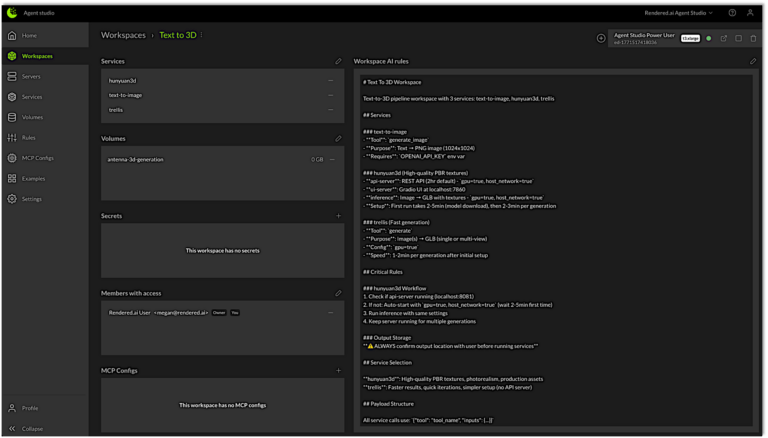
An example Agent Studio workspace where a user can easily configure an AI agent with customized rulesets, context, tool collections (called “Services”), access to data and resource volumes, and more before opening a server to use the agent with your IDE of choice.
It doesn’t replace engineers.
It gives them scalable digital teammates capable of handling complex, repetitive engineering preparation work — safely, persistently, and within governed environments.
As AI moves beyond software development into deep tech, hardware, and physical-world systems, one thing is becoming clear:
The future of engineering will not be powered by generic agents.
It will be built by customizable ones designed for the realities of engineering itself.
Get $250 to Play in Our Sandbox
Join the Rendered.ai Agent Studio while in beta and get a $250 credit toward creating your own model-agnostic AI agents. Or use those credits to get to a production-ready agent faster with our library of readymade agent design workspaces that you can modify for your needs easily, featuring pre-built agentic workflows for:
- End-to-end synthetic data creation for computer vision
- Advanced SAR simulation
- Text-to-3D
- CycleGAN training and inferencing
- YOLO training for thermal
- EMerge antenna design
- FEniCSx-based thermal analysis
- KiCad PCB design
- Ray tracing lens design
- OpenCascade CAD design
- + new AI tool collections added every week
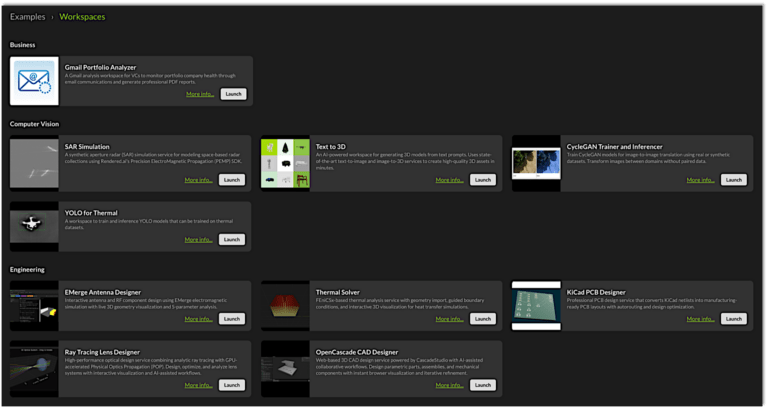
The Agent Studio is loaded with pre-built example workspaces to speed up agent adoption for your deep tech, design, and hardware engineering needs. Fresh examples with new, domain-specific tool collections are released weekly.
Not seeing exactly what you need? Design your own agent to handle your specialized tasks for you with easy AI assistance or the expertise of the Rendered.ai team.
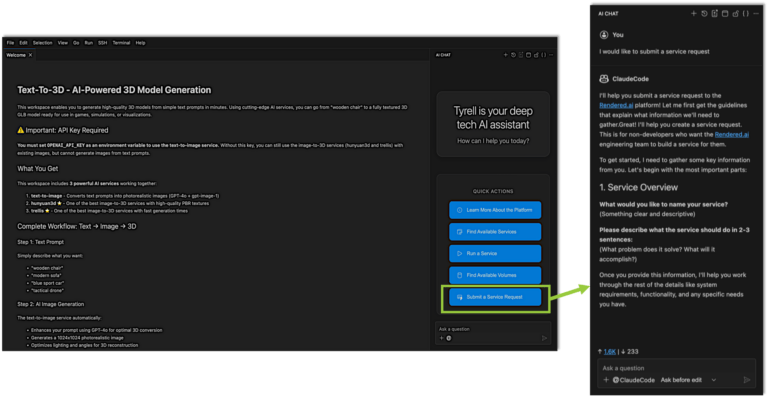
The Agent Studio offers AI-assisted agent creation to build agents from scratch, fully customized to handle the complex, repetitive engineering tasks that keep your team from real innovation.
Your $250 credit will get you far, then it’s only AWS server costs (typically $.50 – $2.00/hour) + 30%.
Low commitment. Low cost. Massive operational impact for deep tech, design, and hardware engineering teams.


